Andrew Lowe Interview, Author of The Ghost
January 02, 2017 | Back
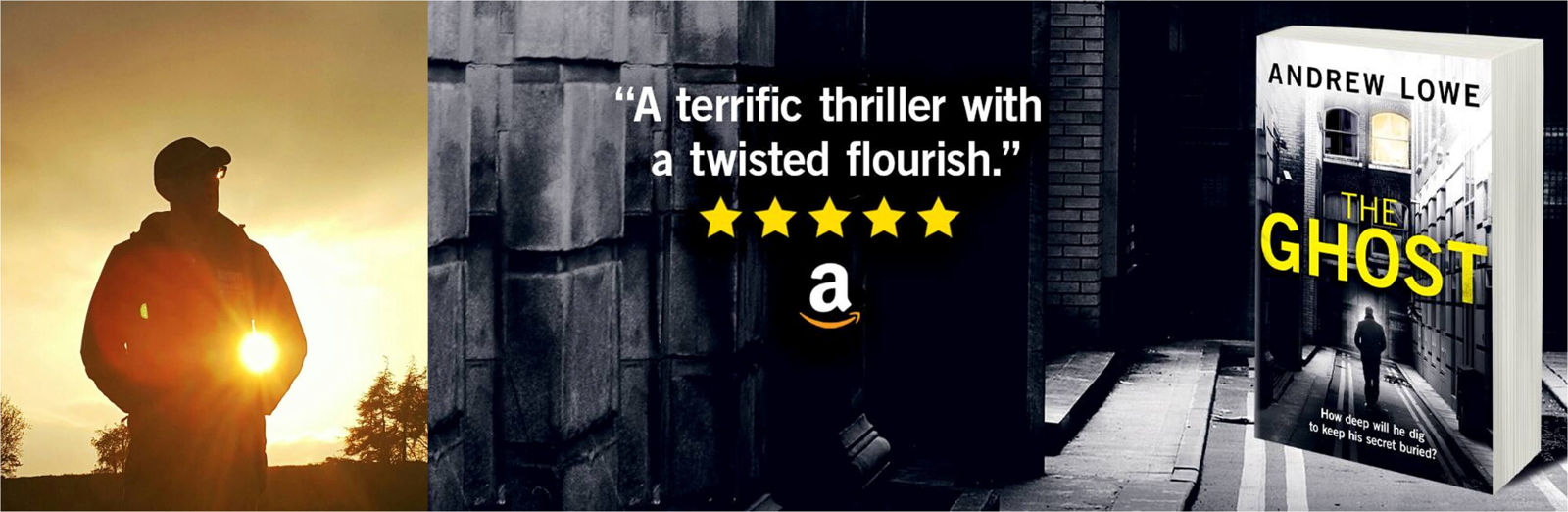
To start off 2017, I thought I′d bring your another author interview, specifically one whose book I thoroughly enjoyed. Today I have author Andrew Lowe from London, England for you. Andrew is the author of The Ghost, a gritty story about a jaded film critic who is haunted by a horrific act of violence from his childhood. Below is my interview with Andrew Lowe.
JORDON: Andrew, thanks for taking the time to answer a few questions for me. First, I′d just like to say that I loved your book, The Ghost. It′s a great and gritty story that kept me reading for sure. Now to begin the interview, tell us why it is you write? What is it that inspires or motivates you to put pen to paper?
ANDREW: I′m filled with stories and I have to get them out! I was that kind of child — always busy inventing and creating, imagining and dreaming. I used to be a journalist, but my first love has always been fiction, because it′s a world where anything goes and you can smuggle all kinds of themes and deeper ideas past readers while they′re busy enjoying the surface-level story.
JORDON: Very good. Along those same lines I believe I once heard a quote in the movie V for Vendetta that went something to the effect of "Authors lie to tell the truth." It′s true though. Next question. Are you a full-time author or do you have another job by day and write by night?
ANDREW: I′m a full-time book editor! I work with other authors to help them turn their manuscripts into publishable books - either independent authors who want to polish the work before they publish themselves, or authors who′re not sure which publishing path they′re going to take, but who want to get the manuscript fit for purpose before it reaches the eyes of agents, publishers, readers, etc.
I used to be a film/culture journalist, but I gave that up a couple of years ago to focus on books. I try to work on a new book over the course of eighteen months/two years. My aim is to publish a new novel every two years, with something else — short story, novella — in between.
JORDON: I imagine that you pulled from your previous career as a film critic when you wrote The Ghost then. So now the question that most authors want to answer first. Can you tell us about your most recently published books?
ANDREW: My debut novel, The Ghost, is about a misanthropic film critic who is harbouring a terrible secret about a childhood prank he instigated over thirty years earlier. Just as his work and marriage start to fall apart, he′s contacted anonymously by someone who also seems to know the secret, and who is out for revenge. It′s a dark thriller about how the experiences of our early years shape the kind of adults we become, and how the past is a constant presence, a haunting, and not something that can be ′forgotten′.
My general aim with my writing is to hit the sweet spot between genre thrillers and literary fiction. Literary thriller, I guess. I love commercial/genre fiction just as much as I enjoy a good chin-stroke over the latest Booker, and I′d like to write books which tap into both: compelling, well-crafted stories with literary layers.
JORDON: What was your favorite scene to write in The Ghost, or what was your favorite type of scene if the former would give too much away?
ANDREW: There′s a scene in The Ghost where the main character — a middle-aged man — gets into a physical fight with another middle-aged man, in a children′s playground. That′s the kind of scene I love to write — deliciously dark but also comical.
JORDON: Now, do you write exclusively in one genre, or do you explore multiple genres or maybe even bend genres? Maybe I should say do you plan to bend genres?
ANDREW: As I say earlier, I want to write dark, messed-up thrillers with literary elements (stylistic, thematic, etc.). I have ideas for sci-fi, YA, horror, and I may write those under specific pseudonyms, Ian Banks/Ian M. Banks-style.
JORDON: I have to agree with you on the dark, messed-up thriller. That′s pretty much exactly what I think I enjoy the most myself. With The Ghost out and I′m assuming more in the works, what would you say is the most rewarding aspect of being an author?
ANDREW: It′s a great justification for hiding yourself away from the real world for a few hours.
JORDON: Haha. Very good point. On the flip side, what would you say is the most challenging part of writing?
ANDREW: I′m sure this will be a popular answer — finding distraction-free time. I have a family constantly buzzing away around me, and so I need to be ruthless in ring-fencing the time to write. I would love to be able to disappear on regular writing retreats with workshops and cake and trees, but it isn′t realistic.
JORDON: Time is always an enemy. Now, I know It′s hard to pick favorites, but who would your top three favorite authors be, and why?
ANDREW: Martin Amis, for the audacity, the swagger, the rockstar sentences. Neil Cross, for the way he writes and understands men. Kurt Vonnegut, for the humanity and humour.
JORDON: Down that same avenue, what are your top three favorite books or series, and why?
ANDREW: London Fields by Martin Amis.
1984 by George Orwell.
Slaughterhouse-Five by Kurt Vonnegut.
A Clockwork Orange by Anthony Burgess.
American Psycho by Bret Easton Ellis.
Can I also have Green River Rising by Tim Willocks? Sorry, I know that′s six not three, but I can′t pick just three!
JORDON: Haha. It′s hard picking just three. Six works. So why are they your favorites?
ANDREW: As for why, they′re all full of the qualities I always admired as a reader and wanted to emulate as a writer: morally ambiguous characters, beautiful phrasing, humanism, strong settings.
JORDON: Now let′s get back to your writing. Some authors write spontaneously, some plan. Can you tell us a little about what your writing process is like?
ANDREW: I plan like crazy, and then, around two-thirds of the way through, the book takes on a life of its own and the plan becomes more and more structural/skeletal. But I need that initial, chapter-by-chapter breakdown, because I love to pepper the writing with recurring themes, surprises, twists, reveals, McGuffins, etc.
JORDON: It′s nice to find other authors who have to plan chapter-by-chapter, even if it′s not the entire story. How some can just write, and it work, I′ll never understand. Another writing question for you. Most stories require at least some type of research on part of the author. What have you enjoyed researching the most to make your stories believable to the reader?
ANDREW: For Savages, I′ve been in touch with a fantastic CEO of an ′adventure travel′ company, who has been helping me keep the logistics of the story believable. But I believe that research will only get you so far, and the skill is to recognise when you′ve reached that point and to just relax and let your imagination take over. The books that get the balance wrong — usually crime/police procedurals — can feel more like written-up research notes than writing. Always print the legend.
JORDON: So many stories out there have happy endings because readers tend to want something happy, something that is a sort of escape. In your opinion, should every story have a happy ending?
ANDREW: I don′t see why. There should be a kind of resolution, but I prefer endings that open up a new kind of future for the characters, leaving it up to the reader to take the story further in their own imaginations. (That′s certainly true of A Clockwork Orange, American Psycho, 1984.) My favourite Neil Cross novel, Always The Sun, has a final sentence that made me physically shudder the first time I read it.
JORDON: It made you physically shudder? Wow, it must have been something else. Now that we′ve looked a little at your writing method, can you tell us a little about your current project?
ANDREW: I′m almost finished with my second novel, Savages, which will be out in Spring 2017. Again, it′s a dark, slow burning thriller about a group of forty-something friends who travel to a deserted tropical island for a ′survival experience′, which turns into a lot more than they′d bargained for. It′s a twisted little satire which, I hope, will have readers simultaneously smiling and gasping in horror.
JORDON: Sounds delightful. I know we covered your favorite authors, but if you had to choose, what author has most influenced your writing?
ANDREW: Probably Neil Cross, as he′s one of the few writers who can operate at that frequency between commercial and literary.
JORDON: How do you deal with writer′s block?
ANDREW: Deny its existence. Also, I treat writing like a job — and just get on with it, at a certain pre-arranged time — rather than viewing it as something that can only happen when ′the muse′ visits.
JORDON: How do you deal with writers block?
ANDREW: I don′t allow writer′s block to stop me. I simply focus on another aspect of the story that I am more inspired to work on. If that doesn′t work out, then a ride on our motorcycle, away from all "life′s clutter," usually does the trick.
JORDON: That seems like a great perspective to have. On a similar note, how much of yourself do you put in your books, in your characters and events?
ANDREW: A lot. I like to pour my demons into the characters, kick them around a bit. There′s a lot of transference going on.
JORDON: Lovely, haha. Let′s move to questions centering more around you as a person. Outside of writing, what are your hobbies?
ANDREW: I coach youth football (currently U12s, but I′ve been working with most of the same kids since they were U7s) and make electronic music with a friend, as Redpoint. Writing/editing is a bit of a black hole, though. It consumes all of your spare time.
JORDON: That it does. As a child, what did you want to do when you grew up?
ANDREW: A heart surgeon! I remember watching a BBC2 documentary series called Your Life In Their Hands. Each episode was a half-hour story of a single operation and I loved the high stakes, the intricacy, the skill, the nobility of the surgeons. I had my appendix out a few years ago and begged the hospital to film it so I could watch it later, but they wouldn′t. I always saw heart and brain surgeons as the rockstars of surgery, but — probably because of the commercial/celebrity dimension — these days it′s probably plastic surgeons.
JORDON: On the entertainment side, what is your favorite song and band? It′s alright if your favorite band doesn′t sing your favorite song, I promise.
ANDREW: Band — Manic Street Preachers. Song — ′Unfinished Sympathy′ by Massive Attack.
JORDON: Now here comes the dangerous question. If you had to pick a favorite politician, who would it be, and why?
ANDREW: Tony Benn. Wise, brave, humane, and a fantastic political educator.
JORDON: Alright, I′ve got two more writing, or book-related questions for you, and I′ll let you go. First, if The Ghost was to be made into a major motion picture and you could choose any actor or actress to play your main character, who would they be?
ANDREW: Michael Fassbender — my favourite actor — for Dorian Cook (the main character in The Ghost). Tom Hardy for Joel Pearce (the main character in Savages).
JORDON: And my last question. Do you ever get revenge on real life people in your fictional stories?
ANDREW: God, yes. All the time. I worry that they′ll recognise themselves and come for actual revenge. There′s a plotline in there somewhere!
JORDON: Haha, well let′s hope they don′t. I think that does it for my questions though, Andrew. Do you have anything else that you′d like to say to the readers?
ANDREW: "Be kind, for everyone you meet is fighting a hard battle." Apparently said by Plato, although it′s disputed. Wonderful sentiment, though, whoever said it.
JORDON: Thanks Andrew. I agree, we never know what others are going through! I think that wraps it up here. Thanks for talking with me today!
If you would like to know more about Andrew Lowe you can find him on the below social network sites and you can also buy copies of his book, The Ghost, at the Amazon links below:
Find Andrew Lowe on www.AndrewLoweWords.com, Facebook, Twitter, Amazon and Goodreads
Get Andrew Lowe′s The Ghost: Amazon US / Amazon UK.
Author Bio:
Andrew Lowe has written for The Guardian and Sunday Times, and contributed to numerous books and magazines on films, music, TV, videogames, sex and shin splints.
He was born in the North of England but now lives in London, where he writes, edits, makes music, and coaches youth football.